
Affiliate marketing has become one of the most practical ways for businesses, publishers, and independent creators to work together online. Instead of relying entirely on traditional advertising, companies can collaborate with people who already have an audience and reward them when their recommendations lead to measurable results. This approach has created opportunities for websites of all sizes, from established publications to small niche blogs.
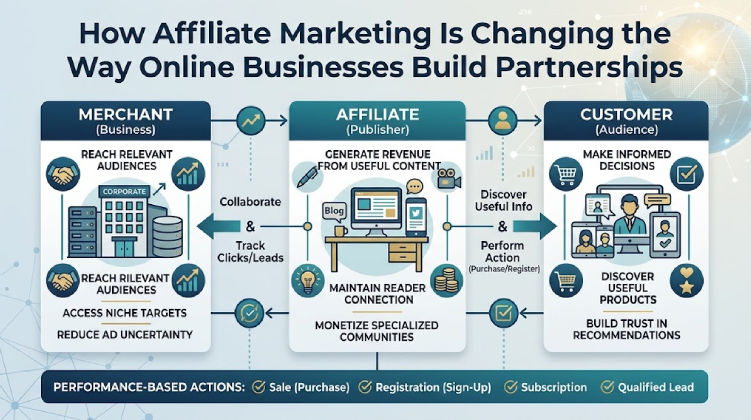
What makes affiliate marketing particularly interesting is its performance-based structure. A business does not necessarily have to pay simply for displaying an advertisement. In many cases, payment is connected to an action such as a purchase, registration, subscription, or qualified lead. For publishers, this creates a way to generate revenue from useful content while maintaining a connection with their readers.
Understanding How Affiliate Marketing Works
The basic concept behind affiliate marketing is fairly simple. There are usually three main participants: the merchant, the affiliate, and the customer.
The merchant provides a product or service and operates the affiliate program. The affiliate promotes that product through a website, social media account, email newsletter, video channel, or another digital platform. When someone interacts with the affiliate’s promotional link and completes the required action, the affiliate may receive a commission.
Tracking technology makes this process possible. Affiliate links normally contain unique identifiers that allow a company or affiliate network to determine where a visitor came from. Depending on the program, commissions can be based on sales, leads, app installations, registrations, or other predefined actions.
For example, a technology website might publish an article comparing several project management tools. If one of those companies operates an affiliate program, the publisher can include a relevant link within the article. A reader who decides to purchase the service through that link may generate a commission for the publisher.
The important point is that successful affiliate marketing usually starts with useful information rather than simply placing as many links as possible.
Why Businesses Use Affiliate Marketing
Businesses are attracted to affiliate marketing because it can provide access to audiences that may be difficult to reach through conventional advertising.
A company selling specialist software, for instance, might find it expensive to reach every potential customer through display advertising. Working with websites that already publish content for developers, freelancers, entrepreneurs, or small businesses can be more targeted.
Affiliate marketing can also reduce some of the uncertainty associated with advertising. A traditional campaign might require payment based on impressions or clicks, while an affiliate campaign can be structured around completed actions.
This does not mean affiliate marketing is risk-free. Businesses still need to invest time in creating suitable programs, reviewing affiliates, preventing fraudulent activity, answering questions, and ensuring that commissions are calculated correctly. However, the performance-oriented model can make the channel attractive when it is managed carefully.
The Role of Content in Affiliate Success
Content remains one of the strongest foundations for affiliate marketing. Readers rarely want to visit an article that exists only to push a product. They are more likely to engage with a recommendation when the content answers a genuine question or helps them make a decision.
This is why comparison articles, tutorials, product reviews, buying guides, case studies, and educational resources are frequently used in affiliate campaigns.
Consider someone searching for information about accounting software for a small business. An article explaining the differences between popular platforms could be much more useful than a page containing several promotional banners.
A strong affiliate article should explain what a product does, who it is suitable for, what its limitations are, and what factors readers should consider before making a decision. If an affiliate relationship exists, the content should also be transparent about it.
Quality matters because readers develop trust over time. A publisher that recommends every product without considering whether it is appropriate can quickly lose credibility.
Choosing the Right Affiliate Partners
Not every affiliate program is suitable for every publisher. The size of a commission should not be the only factor considered.
Relevance is often more important. A website about personal finance will generally have more success promoting financial software, educational resources, or relevant business services than unrelated products.
Publishers should also examine the reputation of the company behind an affiliate program. A product with poor customer service or misleading marketing may create problems even if the commission appears attractive.
Other factors can include commission structure, payment schedule, cookie duration, available promotional materials, tracking reliability, and terms of participation.
For companies, selecting suitable affiliates is equally important. A large audience does not automatically mean that an affiliate will produce valuable customers. A smaller website with a highly relevant audience may deliver better results than a much larger platform with little connection to the product.
Building a reliable network of affiliates is therefore closer to building business relationships than simply purchasing advertising space.
Building Trust With Readers
Trust is particularly important in affiliate marketing because recommendations can influence purchasing decisions.
Readers are generally more receptive when publishers explain both the benefits and limitations of a product. If every review sounds overwhelmingly positive, experienced readers may become suspicious.
Honest comparisons can be more effective. For example, a software review might explain that a particular platform has excellent automation features but may be expensive for very small teams. Such balanced information gives readers something useful even if they ultimately decide not to purchase the product.
Transparency about affiliate relationships is another important part of responsible publishing. Readers should not be left with the impression that an independent recommendation has no commercial relationship when one exists.
The goal should be to create a useful resource first and generate revenue second. In the long run, this approach can support stronger relationships between publishers, audiences, and businesses.
Affiliate Marketing Beyond Traditional Websites
Although websites remain important, affiliate marketing is no longer limited to blogs.
Social media creators can recommend products through videos, posts, stories, and other formats. YouTube channels can include affiliate links alongside product demonstrations. Podcasts can direct listeners toward relevant services. Email newsletters can introduce tools that are useful to subscribers.
Different channels work better for different products.
A visual product may perform well through video content, while a complex business service may benefit from an in-depth written guide. The best affiliates understand where their audience prefers to consume information and adapt their strategy accordingly.
This flexibility has made affiliate marketing accessible to a wide range of publishers. Someone does not necessarily need a huge audience to begin. A smaller community with strong engagement can sometimes be more valuable than a large audience that rarely interacts with recommendations.
Measuring Performance
Affiliate marketing should be treated as a measurable business activity. Publishers and merchants need to understand which campaigns are producing meaningful results.
Common measurements include clicks, conversion rates, earnings per click, sales, leads, average order value, and overall commission revenue.
Suppose an affiliate receives 10,000 visitors to an article but generates only a handful of conversions. Increasing traffic may not solve the underlying problem. The article could be targeting the wrong audience, recommending an unsuitable product, or failing to provide enough information for readers to make a decision.
On the other hand, an article with relatively modest traffic but a strong conversion rate may deserve additional attention. Improving its search visibility, updating outdated information, or creating related content could produce significant results.
Data allows publishers to move away from guesswork and understand what their audience actually responds to.
Common Mistakes to Avoid
One of the most common mistakes is focusing exclusively on commission rates. A high commission is not particularly useful if the product has little relevance to an audience.
Another mistake is publishing thin content simply to insert affiliate links. Search engines and readers increasingly expect useful, original information. A page that offers little value is unlikely to build sustainable traffic.
Overloading an article with links can also make the page feel promotional. Affiliate links should have a clear purpose and fit naturally within the discussion.
Ignoring old content is another missed opportunity. Products change, prices change, features are updated, and affiliate programs can modify their terms. Regularly reviewing older articles helps keep recommendations accurate.
Finally, publishers should avoid making claims they cannot support. Exaggerated promises may produce short-term clicks but can damage credibility and lead to disappointed customers.
Creating Long-Term Affiliate Relationships
The strongest affiliate marketing strategies are built around relationships rather than isolated transactions.
A publisher that consistently sends relevant customers to a business can become an important commercial 1x Partner. Over time, that relationship may lead to better commission rates, exclusive promotions, early access to products, or customized campaigns.
Similarly, businesses can benefit from treating affiliates as partners rather than simply another advertising channel. Providing clear communication, reliable tracking, useful resources, and timely payments can encourage affiliates to invest more effort into promotion.
This relationship-based approach can make affiliate marketing more sustainable. Instead of constantly searching for new promotional opportunities, businesses can develop a network of trusted partners who understand their products and audiences.
The Future of Affiliate Marketing
Affiliate marketing is likely to continue evolving as online consumers become more selective about where they spend their time and money.
Content quality, audience relevance, transparency, and accurate measurement will remain important. At the same time, creators are gaining more opportunities to monetize specialized communities across websites, newsletters, video platforms, and social networks.
Technology will also continue to improve tracking and reporting. Better analytics can help businesses identify which partners are generating valuable customers rather than simply large numbers of clicks.
For publishers, the opportunity is not simply to add commercial links to existing content. It is to understand their audience well enough to recommend products and services that genuinely solve problems.
Affiliate marketing works best when everyone involved receives value. Businesses gain customers, publishers earn revenue, and consumers discover products that may genuinely help them. When the relationship is based on relevance and trust, affiliate marketing becomes more than a promotional tactic—it becomes a practical model for building sustainable online partnerships.
For businesses looking to expand their reach, finding the right Partner can therefore be just as important as choosing the right advertising platform. A strong partnership combines a relevant audience, useful content, transparent communication, and a clear understanding of what both sides want to achieve.
Ultimately, affiliate marketing is not about placing the maximum number of links in front of the maximum number of people. It is about connecting the right recommendation with the right audience at the right moment. Publishers that focus on genuine usefulness and businesses that support their affiliates with quality products are better positioned to build relationships that can continue producing results over time.