
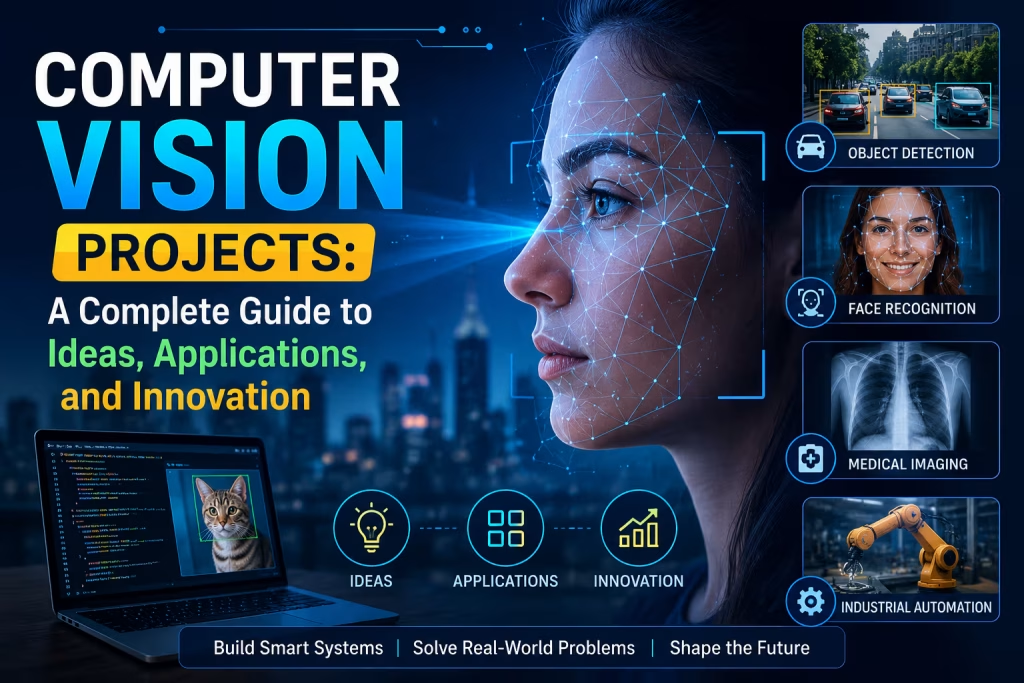
Understanding the Core Idea Behind Computer Vision Projects
Computer vision projects are practical applications of artificial intelligence that enable computers to understand and analyze visual information such as photographs, videos, and camera feeds. Instead of simply displaying an image, a computer vision system can identify objects, recognize patterns, detect movement, classify images, or extract useful information from visual content. These projects are becoming increasingly popular among students, developers, researchers, and technology enthusiasts because they combine programming with real-world problem solving. Python, OpenCV, TensorFlow, PyTorch, and various deep-learning models are commonly used. A project can range from a simple webcam application to an advanced autonomous vehicle system.
Why Computer Vision Projects Matter in Modern Technology
Computer vision has become important because organizations generate enormous amounts of visual data every day. Human beings cannot manually examine every photograph, video frame, security recording, or industrial image. Computer vision helps automate these tasks and allows machines to process visual information quickly.
For example, factories can use cameras to identify defective products, while transportation companies can analyze traffic conditions. Retailers can study product shelves, and agricultural organizations can examine crop images. Educational projects also benefit because students can learn programming, artificial intelligence, mathematics, and data analysis through one practical application.
| Area | Example Computer Vision Use |
|---|---|
| Healthcare | Medical image analysis |
| Agriculture | Crop disease detection |
| Transportation | Traffic monitoring |
| Retail | Product recognition |
| Security | Object detection |
| Education | Interactive learning tools |
| Manufacturing | Quality inspection |
These applications demonstrate why computer vision is more than an academic subject. It is increasingly becoming a practical technology used across many industries.
Read More: Cashstark.com 5G – How to Activate Your 5G SIM from a 4G SIM in 2026
Beginner Project: Real-Time Face Detection
Face detection is one of the most popular beginner-friendly computer vision projects. The primary objective is to identify human faces in an image or live camera feed. A webcam can capture frames continuously, while a computer vision algorithm searches each frame for facial patterns. When a face is found, a rectangular box can be displayed around it.
This project teaches fundamental concepts such as image capture, frame processing, grayscale conversion, object detection, and real-time visualization. Beginners can create the application using Python and OpenCV without requiring an extremely complicated machine-learning pipeline.
The project can also be expanded with additional features. For example, it could count the number of visible faces, detect faces in recorded videos, or trigger an interface response when a face appears. More advanced versions can explore facial landmarks or authorized identity recognition.
However, facial information is sensitive, so developers should consider consent, privacy, and responsible data handling when creating real-world applications.
Smart Object Detection With Deep Learning
Object detection is a more advanced computer vision project because the system must determine both what an object is and where it is located. A photograph may contain multiple objects, and the model needs to identify each relevant item separately.
Modern object-detection frameworks can detect categories such as people, cars, animals, bicycles, bags, and electronic devices. YOLO-style models are particularly popular for projects requiring relatively fast detection.
A useful project idea is a smart traffic detector. A camera could identify cars, buses, motorcycles, bicycles, and pedestrians and then calculate approximate object counts.
The project teaches several important concepts:
- Dataset preparation
- Image annotation
- Model training
- Object localization
- Confidence scores
- Performance evaluation
- Real-time inference
Students can improve the project by adding tracking, counting, or alert functionality. Object detection is valuable because its concepts are closely connected to practical applications in robotics, transportation, manufacturing, retail, and smart-city technology.
Hand Gesture Recognition for Contactless Interaction
Hand gesture recognition provides an interesting way to build a human-computer interaction system. Instead of using a mouse or keyboard, users can perform predefined hand movements that are interpreted by a camera-based application.
For example, a system could recognize an open palm, thumbs-up gesture, pointing direction, or closed fist. Each gesture could correspond to a computer command.
| Gesture | Possible Function |
|---|---|
| Open Palm | Pause |
| Thumbs Up | Confirm |
| Point Right | Next |
| Point Left | Previous |
| Closed Fist | Stop |
Hand-landmark detection can be used to identify important points on the hand, such as fingertips and joints. These points can then be analyzed to classify gestures.
This project is useful for learning real-time image processing and machine learning. It can also be expanded into sign-language recognition, virtual presentation controls, gaming interfaces, smart-home systems, and accessibility tools. The project demonstrates how computer vision can make digital interaction more natural and hands-free.
Read More: Cashstark com Airtel: How to Get Free Recharge on Jio, Airtel, Vi, and BSNL
Optical Character Recognition for Digital Documents
Optical Character Recognition, or OCR, is a computer vision technology that extracts written or printed text from images and converts it into editable digital information. An OCR project can be created to read documents, receipts, signs, labels, or photographs containing text.
The basic process usually involves capturing an image, improving its quality, locating text regions, recognizing characters, and returning the extracted text. Image preprocessing can be especially important. Techniques such as resizing, grayscale conversion, noise reduction, thresholding, and perspective correction may improve recognition accuracy.
A beginner could create an application where a user uploads a photograph and receives the detected text as output. An advanced version could automatically organize extracted information into a database.
Possible applications include:
- Digitizing paper documents
- Reading receipts
- Extracting information from forms
- Creating searchable archives
- Translating photographed text
- Processing printed records
OCR projects demonstrate how computer vision can transform physical information into digital data and are therefore useful in offices, libraries, businesses, and educational environments.
Traffic Sign Recognition for Intelligent Transportation
Traffic sign recognition is an excellent project for students interested in autonomous vehicles and transportation technology. The objective is to identify different road signs from images or video frames.
A dataset containing labeled traffic-sign images can be used to train an image-classification model. The system learns visual characteristics such as shapes, colors, symbols, and patterns. When a new image is provided, the model predicts which category it belongs to.
A more sophisticated project can combine object detection with classification. First, the system locates the traffic sign, and then another model identifies its category.
Real-world conditions make this problem challenging. Rain, fog, shadows, damaged signs, poor lighting, camera movement, and unusual viewing angles can influence predictions. Therefore, project testing should include varied images rather than relying exclusively on ideal examples.
This project provides valuable experience with classification, dataset preparation, neural networks, evaluation metrics, and real-time computer vision.
Plant Disease Detection Through Computer Vision
Agriculture is another field where computer vision projects can create meaningful applications. Many plant diseases produce visible changes in leaves, fruits, or stems. A computer vision system can be trained to classify images according to predefined plant-health categories.
A basic project might distinguish between healthy leaves and several disease classes. The user photographs a leaf, uploads the image, and receives the model’s predicted category.
The quality of the dataset is extremely important. Images should ideally include different backgrounds, lighting conditions, plant varieties, growth stages, and symptom appearances. Otherwise, the model may learn irrelevant visual characteristics instead of disease-related patterns.
This project can be expanded into a broader agricultural assistant capable of identifying plants, monitoring visible symptoms, estimating growth, or organizing field images.
However, an AI prediction should not automatically be treated as professional agricultural advice. A strong project should clearly explain its limitations and encourage appropriate expert verification when decisions have significant consequences.
AI-Based Attendance and Identity Management
A computer vision attendance system demonstrates how image analysis can be connected with databases and administrative software. In a controlled educational prototype, a camera captures an image, detects relevant faces, compares them with authorized records, and records an attendance event.
A simplified workflow might include:
| Step | Process |
|---|---|
| 1 | Capture camera frame |
| 2 | Detect face |
| 3 | Extract visual features |
| 4 | Compare authorized records |
| 5 | Confirm a match |
| 6 | Record attendance |
| 7 | Generate report |
This project is valuable because it combines several areas of software development. Students learn about computer vision, databases, interfaces, authentication, logging, and error handling.
However, identity-related systems require special care. Developers should consider consent, privacy, data security, access permissions, and the possibility of recognition errors. For academic demonstrations, synthetic or authorized datasets are preferable.
The project can also be redesigned without biometric identification by using QR codes, badges, or other privacy-conscious methods.
Advanced Medical Image Analysis Projects
Medical image analysis is among the most challenging areas of computer vision. Projects can involve X-rays, CT images, MRI scans, microscopic images, or other specialized visual data. Machine-learning models can be trained to classify or identify patterns in carefully prepared research datasets.
A student project might classify images into predefined categories. More advanced research can investigate segmentation, where the model identifies specific regions inside an image.
Medical applications require much greater caution than ordinary image-classification projects. A model can perform well on a particular dataset but fail when presented with images from another hospital, scanner, population, or imaging environment. False positives and false negatives may also have serious consequences.
Important evaluation areas include accuracy, sensitivity, specificity, precision, recall, generalization, and dataset quality.
For this reason, educational medical computer vision projects should generally be presented as research or learning systems rather than validated diagnostic tools. They provide an excellent opportunity to study AI while emphasizing responsible development.
Future Opportunities and Innovation in Computer Vision
The future of computer vision projects is likely to involve systems that understand images and videos together with language, sound, and other forms of information. These multimodal systems can potentially provide richer interpretations than traditional image classifiers.
Computer vision is also moving toward edge devices, where visual information can be processed locally rather than always being sent to remote servers. This can reduce response time and may provide privacy advantages when implemented correctly.
Emerging project opportunities include smart robotics, autonomous navigation, intelligent manufacturing, augmented reality, accessibility technology, agricultural monitoring, sports analysis, and environmental observation.
Students who want to enter this field should build their knowledge progressively. A useful learning path can begin with image processing, followed by classification, object detection, segmentation, tracking, and eventually multimodal AI.
The most valuable projects will not simply demonstrate that an AI model can recognize something. They will solve a clearly defined problem, measure performance carefully, explain limitations, and consider ethical and practical requirements.
Conclusion
Computer vision projects provide an exciting pathway for learning artificial intelligence while solving practical visual problems. From simple face detection and OCR applications to sophisticated transportation, agriculture, medical imaging, and robotics systems, there are project ideas suitable for almost every experience level.
The success of a project depends on more than choosing an impressive AI model. Developers need suitable datasets, effective preprocessing, appropriate algorithms, reliable evaluation methods, and a clear understanding of the problem being solved. Responsible development is equally important when projects involve faces, personal information, healthcare images, or surveillance.
For beginners, starting with a small project is often the best approach. Once the basic concepts are understood, features such as real-time processing, object tracking, deep learning, dashboards, and mobile deployment can gradually be introduced.
As artificial intelligence continues to develop, computer vision will remain an important technology for transforming visual data into useful information. Learning through practical projects can therefore provide students and developers with valuable technical skills and a strong foundation for future innovation.