
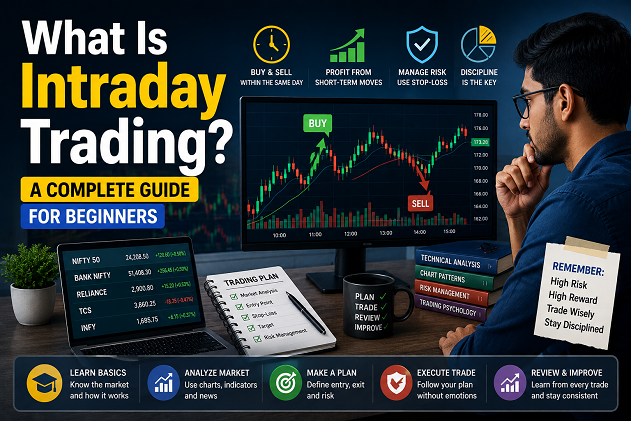
Intraday trading is a stock-market trading strategy in which a trader buys and sells financial assets within the same trading day, with the objective of benefiting from short-term price movements. Unlike long-term investing, where shares may be held for months or years, intraday positions are generally closed before the market session ends.
Intraday trading can involve stocks, exchange-traded funds, currencies, commodities, indices, and other eligible financial instruments, depending on the market and broker. Traders usually rely on price charts, technical indicators, market news, trading volume, and predefined strategies to make decisions.
However, intraday trading is not simply about buying a stock in the morning and selling it in the afternoon. Successful trading requires risk management, discipline, market knowledge, emotional control, and a clear understanding of transaction costs.
This guide explains what intraday trading means, how it works, its major strategies, benefits, risks, essential tools, common mistakes, and practical principles beginners should understand before entering the market.
What Is Intraday Trading and How Does It Work?
Intraday trading means opening and closing a trading position within the same market session. The word “intraday” literally means “within the day.” For example, a trader might purchase 100 shares in the morning at ₹200 per share and sell them later that day at ₹205. The difference, before brokerage and other applicable costs, represents the trading gain.
The opposite can also happen. A trader may identify an expected decline and use an eligible short-selling mechanism, depending on the market’s rules. If the position is closed at a lower price, the trader may potentially benefit from the price movement. However, short selling carries significant risks and is subject to specific regulations.
Intraday trading generally focuses on relatively small price movements rather than long-term company fundamentals. Traders may look for breakouts, reversals, trends, support and resistance levels, or unusual trading volume.
Basic example
| Action | Price |
|---|---|
| Buy 100 shares | ₹200 |
| Sell 100 shares | ₹205 |
| Gross price difference | ₹5/share |
| Gross trading result | ₹500 |
| Less applicable costs | Varies |
| Net result | Depends on costs |
The example is purely illustrative. Actual profits or losses depend on price movement, position size, transaction charges, taxes, slippage, and execution quality.
The most important principle is that intraday trading is short-term speculation, not guaranteed income.
Intraday Trading vs Long-Term Investing: What Is the Difference?
Intraday trading and long-term investing both involve financial markets, but their objectives, time horizons, and decision-making processes are considerably different.
A long-term investor may purchase shares because they believe a company’s earnings, competitive position, management, or future growth can increase its value over several years. An intraday trader is usually more interested in short-term price behavior and may close the position within hours.
Time is therefore one of the clearest differences. An investor might tolerate temporary price fluctuations because the investment thesis extends over a long period. An intraday trader generally cannot rely on a long-term recovery because the position is intended to be closed during the trading session.
Intraday trading vs investing
| Factor | Intraday Trading | Long-Term Investing |
|---|---|---|
| Holding period | Usually within one session | Months or years |
| Primary focus | Short-term price movement | Long-term value/growth |
| Analysis | Often technical | Fundamental + technical |
| Trading frequency | High | Relatively low |
| Transaction costs | Can accumulate quickly | Usually lower frequency |
| Emotional pressure | Often high | Generally lower |
| Main objective | Short-term opportunity | Long-term wealth creation |
| Risk management | Very important | Important |
Neither approach is automatically suitable for everyone. Intraday trading requires active participation and constant attention, while investing requires patience and the ability to tolerate longer-term fluctuations.
A beginner should understand this distinction before assuming that successful investing automatically translates into successful intraday trading.
Why Do People Choose Intraday Trading?
People are attracted to intraday trading for several reasons. The possibility of generating returns from short-term market movements is one of the biggest attractions. Some traders also enjoy the fast pace and analytical nature of the activity.
Another reason is flexibility. A trader may not want to hold a position overnight because unexpected events can cause large price gaps between one trading session and the next. By closing positions before the session ends, traders may attempt to reduce exposure to overnight movements, although intraday trading still carries substantial risk.
Technology has also made trading more accessible. Modern trading platforms provide real-time charts, price alerts, market depth, order management, technical indicators, and other tools that were once available primarily to professional market participants.
Common motivations
| Motivation | Explanation |
|---|---|
| Short-term opportunities | Attempts to benefit from daily price movements |
| Active participation | Allows frequent decision-making |
| Technology | Easy access to charts and trading platforms |
| No intended overnight position | Positions are generally closed before the session ends |
| Strategy development | Traders can test technical approaches |
| Market interest | Appeals to people interested in financial markets |
However, attraction should not be confused with suitability.
A common mistake is entering intraday trading because of social-media claims about quick profits. Markets do not provide guaranteed daily income. A trader can experience several profitable sessions and still lose substantially if risk management is poor.
The right mindset is therefore educational rather than promotional: learn first, practice carefully, and risk only money that can genuinely be lost.
How Intraday Traders Analyze the Market
Intraday traders use different forms of analysis to identify potential opportunities. Technical analysis is particularly common because traders are primarily concerned with price movement over relatively short periods.
Charts can display opening prices, closing prices, highs, lows, and trading volume. Traders may use candlestick patterns to understand buying and selling pressure. Support and resistance levels can help identify areas where price has previously reacted.
Moving averages may be used to identify trends, while indicators such as Relative Strength Index (RSI), Moving Average Convergence Divergence (MACD), and volume-based tools can provide additional information.
Common analysis tools
| Tool | Typical Purpose |
|---|---|
| Candlestick chart | Understand price behavior |
| Moving average | Identify potential trend direction |
| RSI | Study momentum conditions |
| MACD | Analyze momentum and trend relationships |
| Volume | Assess trading activity |
| Support | Identify potential buying-interest zones |
| Resistance | Identify potential selling-pressure zones |
| Trendlines | Visualize directional movement |
Fundamental information can also matter. Company announcements, earnings results, economic data, interest-rate decisions, regulatory developments, and geopolitical events can cause significant short-term price movements.
The important point is that indicators are not prediction machines. A technical indicator can generate a signal that ultimately fails.
Experienced traders therefore tend to combine analysis with risk management. Instead of asking, “How can I guarantee this trade will win?” a better question is, “If this trade is wrong, how much am I prepared to lose?”
Popular Intraday Trading Strategies
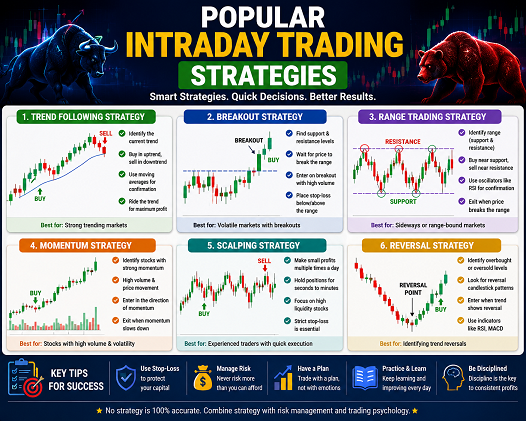
There is no single strategy that works in every market condition. Intraday traders use different approaches depending on volatility, liquidity, market trends, and personal risk tolerance.
One common approach is trend trading, where the trader attempts to participate in an established upward or downward movement. Another is breakout trading, which focuses on price moving beyond an important support or resistance level.
Range trading involves buying near perceived support and selling near perceived resistance when a market moves sideways. Momentum trading focuses on assets showing unusually strong price movement or trading volume.
Scalping is an even shorter-term approach in which traders attempt to capture very small price movements through multiple trades. It can be particularly demanding because transaction costs and execution speed become important.
Strategy overview
| Strategy | Basic Concept | Risk Consideration |
|---|---|---|
| Trend Trading | Trade in the direction of a trend | Trend can reverse |
| Breakout Trading | Trade after a price breakout | False breakouts |
| Range Trading | Trade between support and resistance | Range can break |
| Momentum Trading | Follow strong price movement | Momentum can disappear |
| Scalping | Capture very small moves | High frequency and costs |
| Reversal Trading | Attempt to trade turning points | Difficult timing |
A beginner should avoid using several strategies simultaneously without understanding them. It is generally better to study one straightforward approach, test it with historical or simulated data, and understand its strengths and weaknesses.
No strategy eliminates risk.
Risk Management: The Most Important Part of Intraday Trading
Risk management is arguably more important than finding an exciting trading strategy. A trader can have a good strategy and still lose money if individual losses are allowed to become too large.
One of the most common risk-management tools is the stop-loss order, where appropriate and available. A stop-loss is designed to limit a position’s loss if the market moves against the trader. However, execution can differ from the intended price during fast-moving markets or gaps, so it should not be viewed as an absolute guarantee.
Position sizing is another crucial concept. Instead of risking a large portion of the trading account on one idea, a trader can determine the maximum acceptable loss first and then calculate a position size accordingly.
Example risk framework
| Risk Element | Example Principle |
|---|---|
| Maximum loss per trade | Set before entering |
| Stop-loss | Define invalidation point |
| Position size | Based on acceptable risk |
| Daily loss limit | Stop trading after predetermined loss |
| Leverage | Use cautiously |
| Risk/reward | Compare potential gain with potential loss |
| Emergency fund | Keep separate from trading capital |
For example, someone with ₹1,00,000 in trading capital might decide that losing ₹1,000 on a single trade would be unacceptable beyond their personal risk plan. The appropriate position size would then depend on the distance between entry price and stop-loss.
The numbers are only illustrative. Risk tolerance differs among individuals.
Capital preservation should come before profit maximization. If a trader protects their capital during unfavorable periods, they retain the ability to participate when better opportunities appear.
Leverage and Margin: A Powerful but Risky Tool
Leverage allows traders to control a position larger than the cash they would otherwise need to commit. Brokers and markets may provide margin facilities subject to specific rules and eligibility requirements.
Leverage can make relatively small price movements produce larger gains relative to the trader’s own capital. Unfortunately, the same mechanism can magnify losses.
Suppose a trader controls a ₹2,00,000 position while using ₹50,000 of their own capital through an applicable margin mechanism. A 2% unfavorable movement in the underlying position would represent approximately ₹4,000 before costs. Relative to the ₹50,000 capital used, that represents an 8% loss.
Simplified leverage illustration
| Position Value | Trader Capital | Price Movement | Approx. P/L |
|---|---|---|---|
| ₹2,00,000 | ₹50,000 | +2% | +₹4,000 |
| ₹2,00,000 | ₹50,000 | -2% | -₹4,000 |
| ₹2,00,000 | ₹50,000 | +5% | +₹10,000 |
| ₹2,00,000 | ₹50,000 | -5% | -₹10,000 |
This example ignores brokerage, taxes, interest, margin requirements, slippage, and other costs.
Leverage therefore should never be considered “free money.” It increases exposure and can accelerate losses.
Beginners should understand the broker’s margin rules, liquidation procedures, applicable charges, and risks before using leveraged products.
A simple rule is useful: if you do not fully understand how leverage can magnify a loss, do not use it.
Trading Psychology and Emotional Discipline
Trading psychology is frequently underestimated. A trader may understand charts and indicators but still make poor decisions because of fear, greed, impatience, or overconfidence.
Fear can cause a trader to exit a position too early. Greed may encourage someone to hold a profitable trade beyond their predefined plan. After a loss, revenge trading can occur when the trader immediately enters another position in an attempt to recover the money.
Overconfidence can be equally dangerous. A few successful trades may create the illusion that the trader has discovered a guaranteed system.
Common psychological challenges
| Emotion | Possible Trading Behavior |
|---|---|
| Fear | Exiting too early |
| Greed | Taking excessive risk |
| Anger | Revenge trading |
| FOMO | Entering late |
| Overconfidence | Increasing position size |
| Impatience | Taking low-quality setups |
A trading journal can help identify repeated behavioral mistakes. After each trade, a trader can record the entry reason, exit reason, market conditions, risk level, outcome, and emotional state.
The goal is not to eliminate emotions completely. That is unrealistic. The goal is to prevent emotions from controlling decisions.
Professional behavior means following a predefined plan even when the market behaves differently from expectations.
A disciplined trader accepts that losing trades are part of trading rather than treating every loss as a personal failure.
Costs, Taxes, Slippage and the Real Cost of Trading
Many beginners focus only on whether the buying price is lower than the selling price. However, the actual result of an intraday trade is affected by multiple costs.
Depending on the market and jurisdiction, costs may include brokerage, exchange-related charges, regulatory fees, taxes, and other applicable charges. The exact structure varies by broker and financial instrument.
Slippage is another important factor. Slippage occurs when the actual execution price differs from the expected price. It can become more significant when markets move rapidly or when liquidity is low.
Illustrative cost structure
| Cost | Why It Matters |
|---|---|
| Brokerage | Charged according to broker/product |
| Exchange charges | May apply to transactions |
| Taxes/levies | Depend on jurisdiction and transaction |
| Slippage | Actual execution may differ |
| Spread | Difference between bid and ask |
| Funding/margin costs | May apply to certain products |
Imagine a trader repeatedly makes tiny gains of ₹100 or ₹200. If the combined trading costs and unfavorable execution consume a significant portion of those gains, the strategy may become unprofitable despite having many winning trades.
This is why traders should evaluate net performance, not gross price differences.
A strategy that looks profitable on a chart may produce a completely different result after real-world expenses are included.
Before trading, beginners should check their broker’s current fee schedule and understand the applicable taxes and charges for the specific product.
Common Mistakes Beginners Make in Intraday Trading
Many beginners make similar mistakes when they first enter the market. Recognizing these errors can help reduce avoidable losses.
The first mistake is trading without a plan. A trader may enter because a stock is moving quickly without knowing where to exit if the trade goes wrong.
The second is risking too much on a single position. One bad trade can then damage the entire account.
Another mistake is excessive trading. More trades do not automatically mean more profits. Every additional trade introduces another opportunity for a loss and another set of transaction costs.
Following social-media tips without independent analysis is another dangerous habit. A stock mentioned online may already have moved substantially by the time a beginner enters.
Mistakes to avoid
| Mistake | Better Approach |
|---|---|
| No trading plan | Define entry and exit rules |
| Excessive leverage | Keep exposure controlled |
| Revenge trading | Stop after emotional losses |
| FOMO | Wait for planned setups |
| Ignoring costs | Calculate net results |
| No stop-loss plan | Define risk before entry |
| Overtrading | Focus on quality |
| Copying tips | Conduct independent analysis |
| Using essential savings | Use only risk capital |
| Ignoring records | Maintain a trading journal |
Another common mistake is expecting daily income. Markets do not provide a predictable salary. Some days may offer opportunities, while other days may be unsuitable for a particular strategy.
The ability to not trade is also a trading skill.
Essential Tools and Setup for an Intraday Trader
Technology has become central to modern intraday trading. A trader generally needs a reliable trading account, a suitable platform, real-time market information, charts, and a stable internet connection.
A computer can provide a larger screen for chart analysis, while a mobile device can provide alerts and account access. However, trading solely from a mobile phone can make detailed analysis more difficult for some traders.
Charting software can help traders study price patterns and indicators. Economic calendars can help identify scheduled events that may influence markets. News platforms can provide information about company announcements and broader market developments.
Basic trading setup
| Tool | Purpose |
|---|---|
| Trading account | Place eligible orders |
| Demat/account infrastructure | Hold securities where applicable |
| Charting platform | Analyze price movements |
| Market data | Monitor prices and volume |
| Economic calendar | Track scheduled events |
| News sources | Monitor market developments |
| Trading journal | Evaluate performance |
| Risk calculator | Estimate position size |
| Reliable internet | Support order execution |
Technology should support a strategy rather than replace one.
Having ten indicators on a chart does not necessarily produce better decisions. Too many signals can create confusion and contradictory information.
A simple setup that a trader understands thoroughly can be more useful than an advanced system that the trader cannot explain.
A Beginner-Friendly Roadmap for Learning Intraday Trading
A new trader should avoid treating the market like a quick-money game. A structured learning process can provide a stronger foundation.
The first stage is education. Beginners should understand market orders, limit orders, stop-loss concepts, bid and ask prices, volume, volatility, leverage, margin, and basic technical analysis.
The second stage is observation. Instead of immediately risking real money, beginners can watch markets and record hypothetical trades.
The third stage is strategy testing. Historical data or paper trading can help determine whether a particular strategy has reasonable performance characteristics.
The fourth stage is small-scale implementation, where appropriate and only after the trader understands the risks and applicable rules.
Learning roadmap
| Stage | Main Objective |
|---|---|
| 1. Education | Learn market fundamentals |
| 2. Observation | Understand price behavior |
| 3. Paper Trading | Practice without real capital |
| 4. Backtesting | Examine historical performance |
| 5. Risk Planning | Establish loss limits |
| 6. Small Exposure | Gain controlled real experience |
| 7. Journaling | Identify mistakes |
| 8. Review | Improve the strategy |
A beginner should also understand that paper-trading performance may differ from real trading because emotional pressure, execution, liquidity, and slippage are different.
The goal of the learning process is not to find a magical indicator. It is to build a repeatable process.
Frequently Asked Questions About Intraday Trading
What does intraday trading mean?
Intraday trading means buying and selling a financial instrument within the same trading session, generally with the intention of closing the position before the market session ends.
Is intraday trading profitable?
It can be profitable for some traders, but it also carries substantial risk. There is no guaranteed strategy or guaranteed daily income.
Is intraday trading suitable for beginners?
Beginners can learn about intraday trading, but they should first understand market mechanics, risk management, trading costs, and the possibility of losing money.
How much money is needed for intraday trading?
There is no universal amount. Requirements depend on the market, broker, instrument, margin rules, and trading strategy. More capital does not automatically produce better results.
Can I lose more money than I invest?
The answer depends on the product, account structure, leverage, and trading method. Certain leveraged or derivative products can create substantial losses. Traders should understand the specific risk before entering a position.
What is a stop-loss?
A stop-loss is a risk-management mechanism intended to close a position when the market reaches a predefined level. Actual execution can differ during fast markets or gaps.
Is intraday trading the same as gambling?
They are not identical concepts, but trading without analysis, risk management, or a defined process can become highly speculative. Treating the market as a guaranteed-money game is dangerous.
What is the most important skill in intraday trading?
Risk management and discipline are among the most important skills. A trader needs to control losses, follow a plan, and avoid emotional decisions.
Final Thoughts: Understanding Intraday Trading Before You Start
Intraday trading is a short-term market activity where positions are generally opened and closed within the same trading session to attempt to benefit from price movements. It can offer opportunities, but those opportunities come with significant financial risk.
Successful intraday trading requires more than identifying a stock that is moving. Traders need to understand market structure, technical analysis, position sizing, stop-loss planning, leverage, transaction costs, execution, and psychology.
The most valuable lesson for beginners is that risk management should come before profit expectations. A trader who concentrates only on potential gains may underestimate the speed at which losses can accumulate.
A sensible learning process involves studying the market, practicing with simulated trades, maintaining a journal, testing strategies, and understanding all applicable costs before risking meaningful capital.
Key principles to remember
| Principle | Why It Matters |
|---|---|
| Have a trading plan | Reduces impulsive decisions |
| Control position size | Limits individual losses |
| Understand leverage | Prevents excessive exposure |
| Track costs | Reveals actual profitability |
| Use risk controls | Protects trading capital |
| Avoid emotional trading | Improves consistency |
| Keep learning | Markets constantly change |
| Accept losses | No strategy wins every trade |
| Never risk essential money | Protects financial stability |
| Focus on process | Results are uncertain |
Intraday trading should therefore be approached as a high-risk skill that requires education, preparation, discipline, and continuous evaluation, rather than as an easy shortcut to wealth.
Educational disclaimer: This article is for general educational purposes and is not financial, investment, or trading advice. Financial markets involve the risk of loss. Consider your financial circumstances and consult a qualified financial professional where appropriate before making investment or trading decisions.