
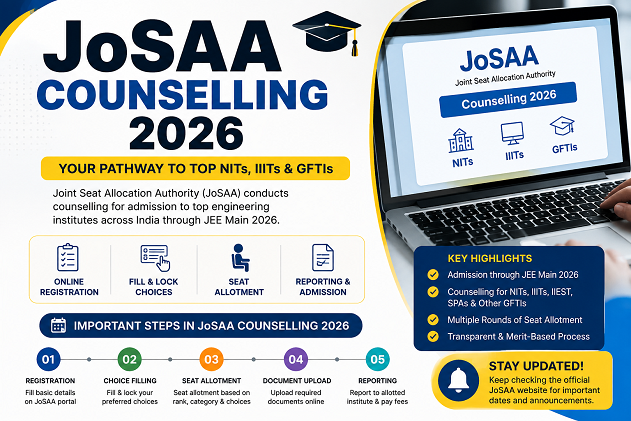
JoSAA Counselling 2026 is the centralized online admission process used for seat allocation to leading engineering and technical institutions in India. The Joint Seat Allocation Authority (JoSAA) 2026 has been established under the Ministry of Education to manage admissions for the 2026–27 academic session. The counselling process covers 138 participating institutes, including 23 IITs, IISc Bengaluru, 31 NITs, IIEST Shibpur, 26 IIITs and 56 Other-GFTIs.
For students who have appeared in JEE Main or JEE Advanced, JoSAA is much more than simply selecting a college. It is a strategic process in which candidates must understand eligibility, institute preferences, branch choices, opening and closing ranks, seat allocation, acceptance options, document verification, fees and subsequent admission procedures.
The official JoSAA portal provides the 2026 schedule, business rules, opening and closing ranks, participating institutes and other admission documents.
What Is JoSAA Counselling 2026 and Why Is It Important?
JoSAA stands for Joint Seat Allocation Authority. It is the centralized authority responsible for coordinating seat allocation for several premier engineering institutions in India. Instead of applying separately to numerous IITs, NITs, IIITs and participating government-funded institutes, eligible candidates can use the JoSAA platform to submit their preferences through a common counselling system.
The importance of JoSAA Counselling 2026 comes from the scale of institutions covered by the process. According to the official JoSAA website, the 2026 system covers 138 institutes, comprising 23 IITs, IISc Bengaluru, 31 NITs, IIEST Shibpur, 26 IIITs and 56 Other-GFTIs.
The counselling process uses candidates’ qualifying examination information and their submitted choices to determine seat allocation. JEE Advanced 2026 is used for IIT admissions, while JEE Main 2026 is relevant for admissions to the NIT+ system and specified programs. The official portal also lists JEE Main B.E./B.Tech., B.Arch. and B.Planning qualifications among the relevant examinations.
A major advantage of the centralized system is that students can compare multiple possibilities before finalizing their choices. For example, a candidate may prefer a particular branch at one NIT over a different branch at another institute, while another student may prioritize the institute name over the branch.
Therefore, JoSAA should not be treated as a formality. It is a decision-making stage that can influence a student’s academic environment, specialization, location, campus experience and future career opportunities.
| Feature | JoSAA Counselling 2026 |
|---|---|
| Full form | Joint Seat Allocation Authority |
| Academic session | 2026–27 |
| Participating institutes | 138 |
| IITs | 23 |
| NITs | 31 |
| IISc Bengaluru | Included |
| IIEST Shibpur | Included |
| IIITs | 26 |
| Other GFTIs | 56 |
| Main platform | Official JoSAA portal |
| Major qualifying exams | JEE Advanced 2026 / JEE Main 2026 |
Because rules and schedules can change, candidates should always compare information from third-party websites with the official 2026 JoSAA documents.
JoSAA Counselling 2026 Eligibility Criteria Explained
Eligibility is one of the most important parts of JoSAA Counselling 2026 because qualifying for JEE Main or JEE Advanced does not automatically mean that every candidate is eligible for every program.
Different institutions and academic programs can have different requirements. The official JoSAA website publishes business rules and separate documents describing special eligibility criteria and restrictions at institute and academic-program levels.
For IIT admissions, candidates generally need to qualify through JEE Advanced 2026 and satisfy the applicable academic requirements. For NITs, IIITs and other institutions under the NIT+ system, JEE Main 2026 performance and program-specific requirements are important.
Candidates should also pay attention to category-related requirements. A candidate applying under a reserved category may need valid supporting certificates in the prescribed format. Similarly, special provisions can apply to PwD candidates and other categories.
Another important point is that eligibility may differ according to the academic program. A student may be eligible for one course but not another because of subject requirements, qualifying marks or other restrictions.
The official JoSAA portal publishes special eligibility and restriction documents for the 2026 admission cycle.
Basic eligibility checklist
| Requirement | What candidates should check |
| JEE qualification | Correct JEE examination and rank |
| Academic qualification | Required Class 12/equivalent criteria |
| Category | General/OBC-NCL/EWS/SC/ST/PwD, where applicable |
| Certificates | Valid and prescribed documents |
| Program restrictions | Subject and institute-specific requirements |
| Gender-related seats | Applicable seat categories |
| State eligibility | Relevant NIT+ provisions |
| Special criteria | Institute/program-specific restrictions |
The safest approach is to read the 2026 JoSAA Business Rules before making final choices. The official authority has published the 2026 business rules for the current admission cycle.
Read More: Step-by-Step Breakdown: Turning a Complex Assignment Into a Simple Plan
JoSAA Counselling 2026 Schedule and Important Stages
The JoSAA 2026 schedule is the timeline candidates should monitor throughout the admission process. The official website provides a dedicated 2026 schedule page, and candidates should rely on that page rather than assuming that dates from previous years will remain unchanged.
The counselling process is generally divided into several important activities, including registration, choice filling, seat allocation, acceptance and reporting. Candidates who receive a seat must carefully follow the deadline associated with their particular round.
For 2026, the official JoSAA website currently reports that the Round 5 seat allocation result has been announced. This means that, as of August 8, 2026, candidates should not treat JoSAA Round 1–5 activities as upcoming events. Instead, students should check their current seat status and follow the applicable post-allocation instructions.
For candidates in the NIT+ system, another important development is the Partial Admission Fee (PAF). JoSAA states that candidates with a provisionally allocated NIT+ seat after Round 5 were required to pay the PAF within the specified July 2026 window. Non-payment was treated as rejection of the allocated seat.
| Stage | Importance |
| Registration | Creates participation in counselling |
| Choice filling | Determines preferred institute/program combinations |
| Choice locking | Confirms submitted preferences |
| Seat allocation | A seat may be assigned according to rules and choices |
| Seat acceptance | Candidate completes required acceptance process |
| Document verification | Eligibility documents are checked |
| Subsequent rounds | Candidates may receive upgraded preferences |
| Fee payment | Required at relevant stages |
| Institute reporting | Final admission-related process |
Because counselling dates can be revised, candidates should check the official schedule regularly.
JoSAA Registration and Login Process for 2026
Registration is the gateway to JoSAA Counselling 2026. Candidates must access the official counselling platform and use the appropriate login method based on their qualifying examination and available credentials.
The registration stage requires candidates to provide or confirm relevant information. It is extremely important that the information matches official examination and identity records.
The JoSAA portal has also provided a specific registration and login guide. According to the official website, candidates without an official @nic.in or @gov.in email ID can use JANPARICHAY with a personal email account such as Gmail or Yahoo for registration/login.
Candidates should avoid creating unnecessary confusion by repeatedly changing personal information. Before proceeding, students should keep their examination details, identification information and relevant documents ready.
A strong registration strategy involves checking every field before submission. Even a small mistake in a category, name, date of birth or examination-related detail can create complications later.
Suggested registration preparation
- Keep JEE credentials available.
- Use a reliable email address.
- Keep a working mobile number.
- Check category information carefully.
- Prepare certificates before counselling.
- Read the business rules.
- Review eligibility restrictions.
- Save important confirmation information.
- Keep copies of submitted documents.
- Monitor official JoSAA notifications.
Candidates should also avoid depending on unofficial social-media posts for critical deadlines. The official portal is the appropriate source for counselling notices and instructions.
Choice Filling Strategy: The Most Important Decision in JoSAA
Choice filling is arguably the most strategic part of JoSAA Counselling 2026. A candidate can have an excellent JEE rank and still receive an unsatisfactory outcome if the preference list is poorly designed.
Students should not create their choices randomly. Every institute-program combination should represent a genuine preference.
For example, a student interested in computer science should compare CSE programs across institutes rather than simply placing colleges in order of popularity. At the same time, students should consider other branches such as Electronics and Communication Engineering, Electrical Engineering, Mechanical Engineering, Civil Engineering, Chemical Engineering and emerging interdisciplinary programs where appropriate.
The correct approach is to create three broad preference groups:
- Dream choices
- Realistic choices
- Safety choices
The list should then be arranged according to the student’s actual priorities.
Example preference framework
| Preference level | Meaning | Example approach |
| Dream | Highly competitive option | Top institute + preferred branch |
| Target | Realistic possibility | Strong institute/branch combination |
| Safe | Higher probability | Acceptable institute and branch |
| Backup | Final acceptable choices | Options the student can genuinely join |
Candidates should study the official Opening and Closing Ranks 2026 before constructing the list. JoSAA has published the 2026 opening and closing rank information on its official portal.
However, previous closing ranks should not be treated as guaranteed predictions. Seat availability, candidate preferences, category, program, gender pool and other factors can influence allocation.
A particularly useful strategy is to ask one simple question for every choice:
“If this is the highest option available to me, would I actually be willing to join?”
If the answer is no, that choice probably should not be placed on the list.
Understanding JoSAA Seat Allotment, Freeze, Float and Slide
Seat allocation can appear complicated because students must understand what happens after receiving a seat. JoSAA’s business rules explain the applicable procedures and options, and candidates should consult the official rules for the exact 2026 provisions.
A candidate who receives a preferred seat must determine whether to continue participating in subsequent opportunities or proceed toward admission.
The fundamental idea is simple: your submitted preference order matters. The allocation system considers available seats and applicable rules while processing candidates’ choices.
Students should never assume that receiving a seat automatically means the counselling process is finished. Depending on the situation and applicable rules, further action may be necessary.
Seat decision framework
| Situation | Candidate’s thinking |
| First-choice seat received | Usually focus on completing admission |
| Acceptable but higher preference remains | Check applicable upgrade option |
| Unwanted seat received | Understand withdrawal/participation rules |
| NIT+ seat after final JoSAA stage | Check PAF and next-stage instructions |
| IIT/IISc seat | Follow institute-specific admission instructions |
One of the biggest mistakes is ignoring deadlines because a student assumes that a seat will remain available automatically. Counselling is deadline-driven.
In 2026, JoSAA specifically warned NIT+ candidates about Partial Admission Fee requirements after the fifth round. The authority stated that failure to pay the PAF within the prescribed period would be treated as rejection of the offered/allocated seat.
Therefore, students should treat every notification as an action item rather than simply reading it as news.
JoSAA 2026 Fees, Seat Acceptance and Partial Admission Fee
Fees are another important component of counselling. Students need to distinguish between different types of payments because seat acceptance and subsequent admission payments are not necessarily the same thing.
A candidate may have to pay the applicable seat acceptance amount after being allocated a seat, depending on the rules and category. Later stages can involve additional institute or admission-related fees.
For NIT+ candidates, the 2026 cycle includes an important Partial Admission Fee requirement. According to the official JoSAA notification, candidates holding a provisionally allocated NIT+ seat after the fifth round were required to pay the PAF in addition to the Seat Acceptance Fee.
The official notice specifies that the PAF payment window was July 22, 2026, at 10:00 AM to July 24, 2026, at 5:00 PM. It also states that non-payment would be treated as rejection of the allocated seat.
This illustrates why candidates must carefully track payment deadlines.
| Payment/step | Purpose |
| Seat Acceptance Fee | Confirms acceptance according to counselling rules |
| Partial Admission Fee | Relevant to NIT+ candidates at the specified stage |
| Institute fee | Payable according to institute instructions |
| Hostel fee | Usually handled separately |
| Other charges | Depend on institute/program |
Candidates should not assume that fee amounts or deadlines from older counselling cycles are still applicable.
The best practice is to use the current JoSAA notification and institute instructions for 2026 rather than relying on outdated articles.
Documents Required for JoSAA Counselling 2026
Document verification is one of the most important administrative stages of counselling. A candidate can have a strong rank and a desirable seat but still face difficulty if the required documents are incomplete, invalid or inconsistent.
The exact documentation can vary according to the candidate’s category, institute, program and admission route. Therefore, students should use the official 2026 business rules and institute instructions as their final checklist.
Commonly relevant documents can include examination-related information, Class 10 and Class 12 documents, category certificates where applicable, identity documents and other prescribed forms.
Candidates should pay special attention to certificates with validity requirements. A category certificate that does not satisfy the prescribed conditions can create serious problems during verification.
Document preparation table
| Document | Why it matters |
| JEE Main/Advanced credentials | Establishes qualifying examination status |
| Class 10 certificate | Identity/date-of-birth information |
| Class 12 certificate/marksheet | Academic eligibility |
| Category certificate | Reservation claim, where applicable |
| PwD certificate | Applicable disability category |
| Identity proof | Verification |
| Passport photographs | Admission documentation |
| Medical/other forms | Where specifically required |
| Undertakings | Where applicable under rules |
JoSAA also publishes special eligibility and restriction documents for individual institutions and programs. Candidates should check these before assuming that a standard document set applies everywhere.
A useful habit is to create both physical and digital copies of important documents. File names should be clear, and scanned documents should be readable.
JoSAA Opening and Closing Ranks 2026: How to Read Them Correctly
Opening and closing ranks are among the most searched pieces of information during JoSAA counselling. They help candidates understand how competitive particular institute-program combinations have been during seat allocation.
JoSAA has published Opening and Closing Ranks 2026 through its official website.
An opening rank generally indicates the highest-ranking candidate who received a particular seat in a specified allocation context, while the closing rank represents the relevant final rank for that seat/category/round combination. However, candidates should understand that ranks must be interpreted with their complete context.
For example, comparing a General category closing rank for one institute with an OBC-NCL closing rank for another program would not provide a meaningful prediction.
Similarly, gender-specific seat pools, home-state and other-state distinctions in the NIT+ system, program type and counselling round can affect the numbers.
Factors influencing closing ranks
| Factor | Potential impact |
| Institute reputation | Can increase competition |
| Branch popularity | Popular branches attract more candidates |
| Candidate preferences | Changes demand |
| Category | Different rank pools apply |
| Seat matrix | Determines availability |
| Counselling round | Ranks can move |
| State quota rules | Relevant to NIT+ admissions |
| New programs | May have different demand |
The best use of rank data is planning, not certainty.
A candidate should therefore create a broad list based on realistic rank ranges rather than selecting only the colleges that appeared in one previous year’s cutoff list.
Final Admission, Reporting, CSAB and Smart Next Steps After JoSAA 2026
JoSAA counselling does not always represent the final stage for every student, particularly within the NIT+ system. Candidates must understand what happens after the JoSAA rounds and whether they need to take further action.
For 2026, the official JoSAA website states that candidates under the NIT+ system who have paid the required Partial Admission Fee and are not participating in CSAB 2026 Special Rounds and/or DASA 2026 (UG) are scheduled for physical reporting at their allotted institute from August 13 to August 18, 2026.
The same official notice directs candidates to the CSAB portal for CSAB 2026 Special Rounds and DASA 2026 (UG) information.
This is especially important for students who do not obtain their preferred NIT/IIIT/GFTI seat through the main JoSAA process or who want to explore eligible vacancies through subsequent procedures.
For IIT and IISc admissions, institute-specific reporting and admission instructions should be checked carefully. JoSAA states that physical reporting schedules for IITs/IISc are updated through institute profiles on the portal.
Post-JoSAA checklist
| Action | Importance |
| Check final seat status | Essential |
| Complete required fee payments | Essential |
| Download/save allotment information | Recommended |
| Complete document verification | Essential |
| Check institute instructions | Essential |
| Track physical reporting | Essential |
| Consider CSAB where eligible | Important for NIT+ candidates |
| Arrange accommodation/travel | Practical preparation |
| Preserve payment receipts | Recommended |
The most important lesson is that seat allocation is not the same as completed admission. Students should continue following official instructions until the institute confirms the required admission process.
Conclusion
JoSAA Counselling 2026 is a strategic admission process rather than a simple college-selection form. Candidates need to understand eligibility, registration, choice filling, seat allocation, fees, documents, ranks and reporting requirements before making decisions.
The 2026 counselling cycle is particularly important because it covers a large network of premier institutes. The official authority states that JoSAA 2026 is handling admissions for 138 institutes, including 23 IITs, IISc Bengaluru, 31 NITs, IIEST Shibpur, 26 IIITs and 56 Other-GFTIs.
As of August 8, 2026, the official portal reports that the Round 5 seat allocation result has been announced. NIT+ candidates should also be aware of the post-Round-5 Partial Admission Fee requirements and subsequent reporting/CSAB procedures.
The strongest strategy is to make decisions based on a combination of JEE rank, genuine academic interests, branch preference, institute quality, location, fees, career goals and realistic cutoff analysis.
Students should avoid choosing a branch simply because it is popular. A less fashionable branch at an excellent institute can sometimes be a better long-term choice than a highly competitive branch at an institution that does not match the student’s priorities. Similarly, students should not blindly follow friends’ preferences because every candidate has a different rank, interest and career objective.
Finally, the official JoSAA website should remain the primary source for 2026 counselling information. The authority publishes the schedule, business rules, opening and closing ranks, participating institutes and important notifications.
A successful JoSAA journey therefore depends on three things: accurate information, thoughtful choice filling and strict deadline management. Candidates who approach all three carefully can make the counselling process considerably more predictable and use their JEE performance to secure an academic opportunity that genuinely fits their future goals.