
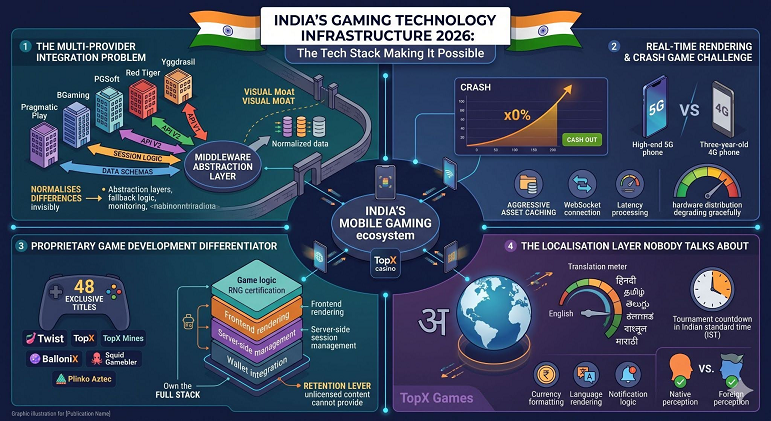
India’s online gaming market is frequently analysed through the lens of user numbers and revenue projections. Less examined is the technology infrastructure that makes the experience possible at the scale India demands — millions of concurrent sessions, real-time multiplayer interactions, and game libraries spanning thousands of titles, all delivered reliably to a fragmented hardware base over mobile connections of varying quality. Platforms like https://topx-games.com/ — aggregating over 4,000 games from providers including Pragmatic Play, BGaming, PGSoft, Red Tiger and Yggdrasil, alongside 48 proprietary titles, and delivering everything via PWA to Indian users on PhonePe, UPI and PayTM — offer a useful lens for examining what that technology stack actually looks like in practice.
The Multi-Provider Integration Problem
Building a game library of meaningful scale is not primarily a content curation challenge — it is a systems integration challenge. Each game provider operates its own API, with its own authentication protocols, session management logic, data schemas and update cadence. Aggregating content from twenty, thirty or fifty providers into a single coherent user-facing experience requires middleware that normalises these differences invisibly, so that a player switching from a Pragmatic Play slot to a BGaming crash game to a JiliGames title experiences seamless continuity rather than a series of technically distinct products stitched together.
The complexity scales non-linearly with the number of providers. Two integrations are manageable. Twenty integrations, each with their own edge cases, version updates and occasional downtime, require dedicated engineering investment in abstraction layers, fallback logic and monitoring infrastructure. Platforms that have solved this well carry a meaningful technical moat — not because the individual integrations are impossible to replicate, but because the operational discipline required to maintain them reliably at scale takes years to build.
Real-Time Rendering and the Crash Game Technical Challenge
No game category places higher demands on the client-side technical stack than crash games. Titles like Aviator, JetX and VORTEX require a multiplier curve to render smoothly and update in real time, with player actions — the cash-out decision — processed server-side with latency low enough that the result feels instantaneous. On a high-end device with a stable 5G connection, this is straightforward. On a three-year-old mid-range Android phone on a variable 4G signal in a Tier-2 Indian city, it requires deliberate engineering choices.
The solutions that work involve aggressive asset caching to reduce render-cycle dependency on network state, WebSocket connections with reconnection logic that handles intermittent drops without losing session state, and UI architectures that degrade gracefully when frame rates drop rather than producing broken experiences. Platforms that handle these edge cases cleanly retain users who might otherwise attribute poor performance to the product rather than their network conditions.
Proprietary Game Development as a Technical Differentiator
Beyond third-party aggregation, a distinct technical challenge exists for platforms that develop proprietary titles. TopX Games — the platform’s catalogue of 48 exclusive titles including Twist TopX, TopX Mines, BalloniX, Squid Gamebler and Plinko Aztec — represents an in-house game development capability that sits on top of the aggregation infrastructure rather than alongside it.
Building proprietary games means owning the full stack: game logic, RNG certification, frontend rendering, server-side session management and integration with the platform’s existing wallet and user management systems. The engineering overhead is substantial, but the strategic rationale is clear. Exclusive titles cannot be found on competing platforms, which creates a retention lever that licensed content cannot provide. For players who cycle through third-party game libraries quickly, the availability of titles that exist only on one platform is a genuine reason to maintain platform loyalty.
The Localisation Layer Nobody Talks About
Technical discussions of gaming platforms tend to focus on the game layer and the payment layer. Less discussed is the localisation middleware that sits between a globally built platform and an Indian user. Currency formatting, language rendering for Hindi and other Indian scripts, time zone handling for tournament countdowns, and notification logic calibrated to Indian usage patterns — these are unglamorous engineering problems that nonetheless directly affect whether the product feels native or foreign to its target audience.
Platforms that handle this layer well produce experiences that Indian users describe as intuitive without being able to articulate exactly why. Those that handle it poorly produce subtle friction points — amounts displayed in unexpected formats, interfaces that switch to English mid-flow, tournament timers that reference UTC — that accumulate into a perception of a product that was not really built for India, regardless of how technically sophisticated the underlying stack might be.
Performance at India’s Hardware Distribution
The final technical variable that distinguishes India-ready gaming platforms from those that merely operate in India is performance across the actual hardware distribution of the market. Benchmarking against flagship devices produces misleading results. The median device in India’s active gaming user base is a mid-range Android handset with 3 to 4 GB of RAM, a processor from two or three generations ago, and storage that is perpetually constrained by a combination of pre-installed apps and media accumulation.
PWA delivery addresses part of this challenge by avoiding the storage cost of native installation and leveraging browser-level optimisation. But PWA is a delivery mechanism, not a performance guarantee. The underlying game assets, rendering logic and network handling still need to be engineered with constrained hardware in mind from the design stage. In 2026, the platforms that made those engineering investments early are the ones delivering consistent experiences across India’s full device distribution — and consistency, in a market this large and this competitive, is ultimately what retention is built on.