
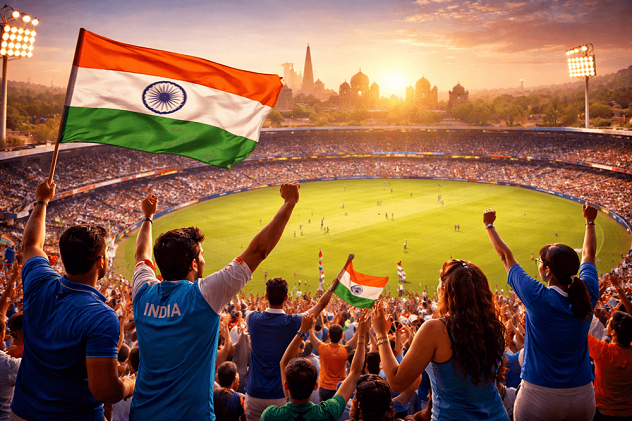
India’s cricket year never really stops. It bends around monsoons at home, television windows abroad, and the demands of a global calendar that now runs almost 12 months. What looks like a blur of series and tournaments on the surface is actually a carefully stitched pattern, designed to keep India playing, watching, and commercially relevant across seasons and time zones.
The result is a schedule that has to serve many masters at once: the BCCI, broadcasters, the ICC, overseas boards, players, and a fan base that expects meaningful cricket almost every week.
India’s home season and the logic of weather
The starting point is simple geography. India’s traditional home season runs from roughly October to March, when conditions are dry and pitches are predictable. This is when full Test series, marquee bilateral contests, and high-profile white-ball games are most likely to be scheduled.
Monsoon months from June to September make large parts of the country unreliable for long series. That is why India often tour during this period, heading to England, the Caribbean, Sri Lanka, or other venues where weather is more stable. The pattern is not perfect, but over time it has created a rough rhythm: host when the skies are clear, travel when they are not.
This weather-driven structure has knock-on effects. Domestic tournaments like the Ranji Trophy, Vijay Hazare Trophy, and Syed Mushtaq Ali Trophy are slotted around international commitments, often squeezed into windows that keep players moving but not overloaded. The IPL, sitting in the March to May window, has become its own season, with international boards adjusting their calendars to accommodate it.
Global seasons and competing priorities
Cricket’s global calendar is not centrally controlled. Each board has its own priorities, and the ICC tries to overlay global events on top. For India, that means aligning with several different “seasons” at once.
The English summer, from May to September, is prime time for Tests and limited-overs series in the UK. The Australian summer, from November to January, is another anchor. South Africa, New Zealand, and the Caribbean have their own peak periods. India’s schedule has to weave through all of these, while still protecting its home season and the IPL.
This leads to a few recurring patterns:
- India often tour England or the Caribbean during the northern summer.
- Tours to Australia and New Zealand tend to fall during the Indian winter.
- Shorter white-ball series are used to fill gaps between larger commitments.
The result is a calendar where Indian fans can expect meaningful cricket in almost every month, but with different time zones and formats shaping how they watch and engage.
ICC events and the global spotlight
Layered on top of bilateral cricket are ICC tournaments. Men’s and women’s World Cups, T20 World Cups, Champions Trophy editions, and the World Test Championship final all occupy premium slots in the global year. These events are usually placed in windows that minimise clashes with domestic leagues and maximise broadcast reach.
For India, these tournaments are more than just fixtures. They are national events that reshape viewing habits, advertising cycles, and even work schedules. Fans track major international tournaments months in advance, planning around group stages, knockouts, and potential India match-ups.
Because these events are hosted across different regions, India’s calendar has to flex. A World Cup in England means early evening starts for Indian viewers. A T20 World Cup in Australia pushes matches into early morning or late afternoon slots. The team’s preparation tours, warm-up games, and rest periods are all built around these anchor events.
This alignment with global seasons ensures that India are not just participants but central characters in the sport’s biggest storylines, regardless of where the tournament is played.
Fans, broadcasters and the digital layer
The way the calendar is structured has a direct impact on how Indians consume cricket. Evening home games fit neatly into work and college routines. Overseas tours often turn into early morning rituals, with fans catching the first session over breakfast or on the commute.
Broadcasters build programming blocks around these patterns, from pre-match shows to late-night highlights. Streaming platforms add another layer, allowing fans to follow sessions on phones during travel or breaks.
Digital behaviour has evolved alongside this. Match days drive spikes in fantasy contests, social media chatter, and second-screen use. Spaces that blend cricket-focused gaming coverage with fixtures, basic stats, and simple explanations of formats have become part of the match-day routine for many younger fans.
The calendar also shapes when brands spend. IPL windows and ICC tournaments attract the heaviest advertising, while quieter bilateral series see more targeted campaigns. For platforms tied to cricket, aligning promotions and product features with these peaks is now standard practice.
The future shape of India’s cricketing year
Looking ahead, the alignment between India’s calendar and global seasons will only get more complex. More women’s cricket, potential expansion of franchise leagues, and evolving ICC event cycles will all demand space.
A few trends are already visible.
First, player workload management is becoming a serious scheduling factor. Rest periods, rotation policies, and format-specific squads will influence how many tours India can realistically undertake in a year.
Second, climate considerations may gradually reshape traditional windows. Heatwaves, changing monsoon patterns, and air quality concerns could push certain venues into narrower slots, forcing more creative scheduling.
Third, the balance between bilateral cricket and global events will stay under debate. Boards need bilateral series for revenue and relationships, but fans increasingly focus on marquee tournaments and high-stakes contests.
Through all of this, one constant remains: India’s central role in the cricket economy. As long as Indian audiences drive viewership and revenue, the global calendar will continue to bend around their seasons, even as it tries to serve the rest of the cricketing world.
The challenge for administrators is to keep that balance sustainable. The challenge for fans is simpler, if not always easy: keeping up with a sport that rarely pauses, and a team that seems to be everywhere at once.